

Few molecules in the human body punch above their weight the way nitric oxide does. It is a colorless gas produced naturally by your cells, and it plays a central role in keeping your cardiovascular system running smoothly. Understanding how it works — and what happens when production declines — is foundational to understanding circulatory health.
What Is Nitric Oxide?
Nitric oxide (NO) is a signaling molecule synthesized primarily by the endothelium, the thin layer of cells lining the interior of blood vessels. It was so significant to cardiovascular science that the researchers who discovered its role in vascular biology — Robert Furchgott, Louis Ignarro, and Ferid Murad — were awarded the Nobel Prize in Physiology or Medicine in 1998.
The body produces nitric oxide through two main pathways. The first is enzymatic: the amino acid L-arginine is converted to L-citrulline by a family of enzymes called nitric oxide synthases (NOS), with the byproduct being nitric oxide itself. The second is dietary: nitrates found in vegetables like beets, leafy greens, and arugula are converted through a stepwise bacterial and enzymatic process — nitrate to nitrite to nitric oxide — particularly in low-oxygen environments like working muscle tissue (Lundberg et al., 2008).
How Nitric Oxide Supports Circulation
Once produced, nitric oxide diffuses into the smooth muscle cells surrounding blood vessels, where it activates an enzyme called soluble guanylate cyclase (sGC). This produces cyclic GMP (cGMP), which triggers muscle relaxation and vasodilation — the widening of blood vessels. The result is reduced vascular resistance and improved blood flow throughout the body (Moncada & Higgs, 2006).
This mechanism has several important downstream effects:
Lower blood pressure. By relaxing arterial walls, nitric oxide allows blood to move more freely, reducing the pressure placed on vessel walls. Research published in Hypertension found that endothelial nitric oxide synthase (eNOS) activity is strongly associated with blood pressure regulation (Förstermann & Sessa, 2012).
Improved oxygen delivery. Greater vessel dilation means tissues — including the heart, brain, and skeletal muscle — receive more oxygen-rich blood during both rest and exercise. This is especially relevant for athletic performance and recovery.
Inhibition of platelet aggregation. Nitric oxide signals platelets not to clump together unnecessarily. This helps prevent the formation of blood clots that can obstruct vessels, a key protective mechanism against cardiovascular events (Radomski et al., 1987).
Anti-inflammatory effects at the vessel wall. Nitric oxide reduces the expression of adhesion molecules that allow immune cells and inflammatory agents to stick to the vessel lining, helping to preserve endothelial integrity over time (Peng et al., 1995).
The Age-Related Decline in Nitric Oxide
Here is where the conversation becomes particularly relevant for men and women over 40. Nitric oxide production does not remain constant across a lifetime. Research shows it declines progressively with age, driven by several interconnected factors.
As the endothelium ages, eNOS activity decreases. Oxidative stress — the accumulation of reactive oxygen species — scavenges available nitric oxide before it can act, reducing its bioavailability. The enzyme arginase also becomes more active with age, competing with NOS for L-arginine and further limiting production (Taddei et al., 2001).
A 2015 review in the journal Nitric Oxide estimated that production in older adults can be 50% lower than in younger individuals, contributing meaningfully to the increases in blood pressure, reduced exercise tolerance, and vascular stiffness commonly associated with aging.
This decline is not inevitable or irreversible, but addressing it requires intentional nutritional and lifestyle strategies.
Diet, Exercise, and Nitric Oxide
Several evidence-based strategies can support endogenous nitric oxide production.
Dietary nitrates. Foods high in nitrates — particularly beets, spinach, rocket (arugula), and Swiss chard — are among the most studied dietary sources of NO support. A landmark 2010 study in the American Journal of Clinical Nutrition found that dietary nitrate supplementation significantly reduced systolic blood pressure and improved endothelial function in healthy adults (Lidder & Webb, 2013).
L-arginine and L-citrulline. These amino acids are direct precursors to nitric oxide via the NOS pathway. L-citrulline has actually shown superior oral bioavailability compared to L-arginine, as it avoids first-pass metabolism in the gut and liver more effectively, leading to higher sustained plasma L-arginine levels (Schwedhelm et al., 2008).
Polyphenols and antioxidants. Plant compounds such as quercetin, epicatechin (found in dark chocolate and green tea), and resveratrol have been shown to upregulate eNOS expression and protect existing nitric oxide from oxidative degradation (Rodrigo et al., 2011).
Aerobic exercise. Physical activity is one of the most potent natural stimulators of eNOS activity. The shear stress created by increased blood flow during exercise mechanically activates endothelial cells to produce more nitric oxide. Regular moderate-intensity aerobic exercise has been associated with sustained improvements in endothelial function and NO bioavailability in clinical studies (Green et al., 2004).
Sun exposure. UVA radiation from sunlight can trigger nitric oxide release from stores in the skin, a pathway now recognized as a contributing factor to the cardiovascular benefits associated with moderate sun exposure (Liu et al., 2014).
Nitric Oxide and Sexual Health
One area where nitric oxide plays a well-documented role is sexual health in men. The physiological mechanism behind erection is nitric oxide dependent: sexual arousal triggers NO release in the corpus cavernosum of the penis, relaxing smooth muscle and allowing blood to engorge the erectile tissue (Burnett, 1997).
This is why phosphodiesterase-5 (PDE5) inhibitors — the class of drug that includes sildenafil (commonly known as Viagra) — work by blocking the enzyme that breaks down cGMP, the downstream messenger of nitric oxide. They do not generate erections themselves; they preserve the NO-triggered signal. Supporting upstream nitric oxide production through nutrition and supplementation is therefore a logical and complementary approach to maintaining sexual function as men age.
The Gut Microbiome Connection
Emerging research has drawn attention to the role of oral and gut bacteria in the nitrate-to-nitrite-to-nitric-oxide pathway. Certain species of bacteria on the tongue and in the digestive tract are essential for reducing dietary nitrate to nitrite, an intermediate step required before nitric oxide can be generated. Antibacterial mouthwashes, which disrupt oral microbiota, have been shown to impair this conversion and blunt the blood pressure benefits of dietary nitrate (Govoni et al., 2008). Maintaining microbiome health is therefore an underappreciated component of nitric oxide support.
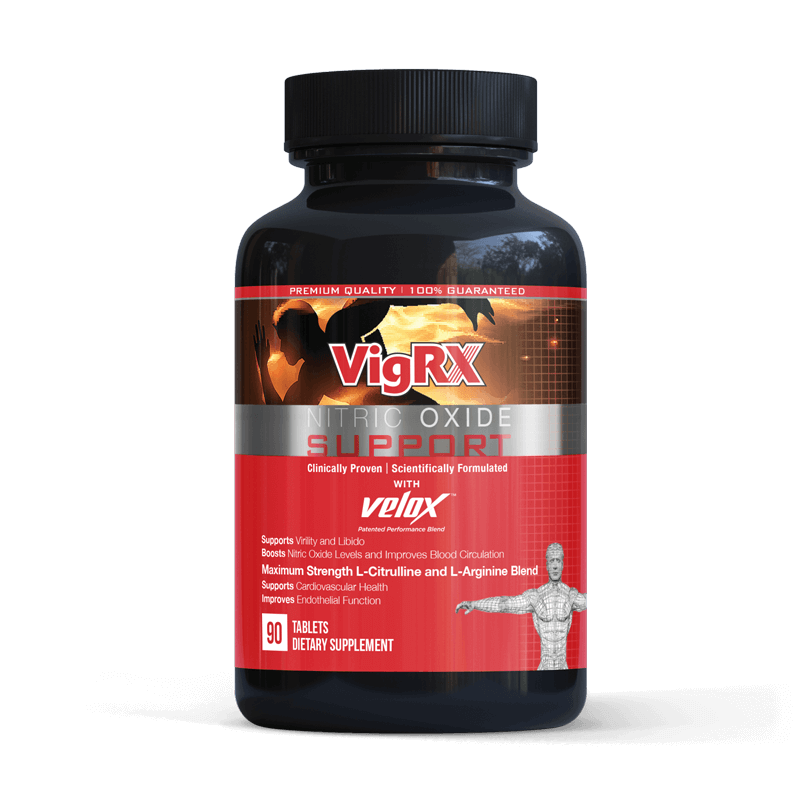
VigRX® Nitric Oxide Support
For men looking to address the age-related decline in nitric oxide production directly, VigRX® Nitric Oxide Support is formulated to target exactly this pathway. The supplement combines clinically studied ingredients — including L-citrulline and standardized plant-based nitrate sources — that work synergistically to promote endothelial function, support healthy blood flow, and sustain the physiological signaling that underlies both cardiovascular performance and sexual vitality. Rather than masking symptoms, the formulation works upstream, giving the body what it needs to produce nitric oxide more efficiently and protect it from oxidative breakdown. It is not meant to replace the advice or assistance of a physician for men suffering from serious medical conditions, but rather is meant for men who want to give themselves a healthy, natural boost for circulatory and cardiovascular health.
What sets VigRX® Nitric Oxide Support apart is its focus on the whole NO pathway. From precursor amino acids to antioxidant protection against nitric oxide scavenging, the formula is designed with the science of vascular biology in mind. For men over 40 who are noticing the effects of reduced circulation — whether in the gym, in daily energy levels, or in the bedroom — this is a targeted option worth considering as part of a comprehensive approach to cardiovascular and men’s health.
References
Burnett, A. L. (1997). Nitric oxide in the penis: Physiology and pathology. Journal of Urology, 157(1), 320–324.
Förstermann, U., & Sessa, W. C. (2012). Nitric oxide synthases: Regulation and function. European Heart Journal, 33(7), 829–837.
Govoni, M., et al. (2008). The increase in plasma nitrite after a dietary nitrate load is markedly attenuated by an antibacterial mouthwash. Nitric Oxide, 19(4), 333–337.
Green, D. J., et al. (2004). Exercise and vascular adaptation in asymptomatic humans. Experimental Physiology, 89(5), 485–494.
Lidder, S., & Webb, A. J. (2013). Vascular effects of dietary nitrate (as found in green leafy vegetables and beetroot) via the nitrate-nitrite-nitric oxide pathway. British Journal of Clinical Pharmacology, 75(3), 677–696.
Liu, D., et al. (2014). UVA irradiation of human skin vasodilates arterial vasculature and lowers blood pressure independently of nitric oxide synthase. Journal of Investigative Dermatology, 134(7), 1839–1846.
Lundberg, J. O., Feelisch, M., Björne, H., Jansson, E. A., & Weitzberg, E. (2006). Cardioprotective effects of vegetables: Is nitrate the answer? Nitric Oxide, 15(4), 359–362.
Moncada, S., & Higgs, A. (1993). The L-arginine-nitric oxide pathway. New England Journal of Medicine, 329(27), 2002–2012.
Peng, H. B., et al. (1995). Nitric oxide inhibits LPS-induced NF-kB activation in human monocytes. Biochemical and Biophysical Research Communications, 214(3), 1010–1016.
Radomski, M. W., Palmer, R. M., & Moncada, S. (1987). The anti-aggregating properties of vascular endothelium: Interactions between prostacyclin and nitric oxide. British Journal of Pharmacology, 92(3), 639–646.
Rodrigo, R., et al. (2011). Relationship between oxidative stress and essential hypertension. Hypertension Research, 34(4), 431–442.
Schwedhelm, E., et al. (2008). Pharmacokinetic and pharmacodynamic properties of oral L-citrulline and L-arginine: Impact on nitric oxide metabolism. British Journal of Clinical Pharmacology, 65(1), 51–59.
Taddei, S., et al. (2001). Aging and endothelial function in normotensive subjects and patients with essential hypertension. Circulation, 103(9), 1330–1335.